The Difference Between Real Leather and Vegan Leather
At first glance, the differences between real leather and vegan leather seem negligible. On further
Humans have been using leather for thousands of years. In catching and slaughtering animals for food, the whole carcass was used and nothing was wasted. Traces of leather have been found on excavated bodies dating back as far as the Bronze Age as shoes and clothing, then subsequently as containers, accessories and tools. Leather is as commonly used today as it has always been, although modern leather manufacturing has evolved into a mass market industry with small artisan leatherworkers very much a minority.
Leather is made from the hides of animals. In the UK the most common type of leather is cowhide, but leather can also be made from sheepskin, goatskin, and using the skin of other kinds of animals such as buffalo, deer, camel and even crocodile.
Cowskin is a byproduct of the cattle industry as the skin of the carcass is removed at the abattoir before the meat can be butchered into different cuts. In the past cowhides were in high demand for use in making clothing, accessories, upholstery and footwear but the increase in mass produced meat and the rise of fast fashion means more hides are going to waste than ever before and consumer demand for high-quality leather has declined.
There are different types of leather, each with unique properties and uses. Depending on where the hide is cut will often dictate what the hide is used for. A whole leather hide is the entire skin of the animal which will include the soft, malleable sections and the thicker hefts that are more durable. This type of cowhide is cut across the belly, so the hide contains a choice of hefts to work with. You can also slice the leather on the side, across the shoulders, from the rump and around the belly. Belly leather has grown and shrunk with their dietary intake making it more supple and stretchy than the tougher skin from the shoulders.
Leatherworkers will use different cuts of hide depending on the item they’re making, ensuring that the properties they need in their final products will be present. Some cuts come with a premium price which often dictates the end product price.
Leather can be broken down into five main types. Full-grain leather, top-grain leather, genuine leather and bonded leather are all made from animal hides in some form. Faux leather refers to leather that either looks like real leather products or contains some of the same properties.
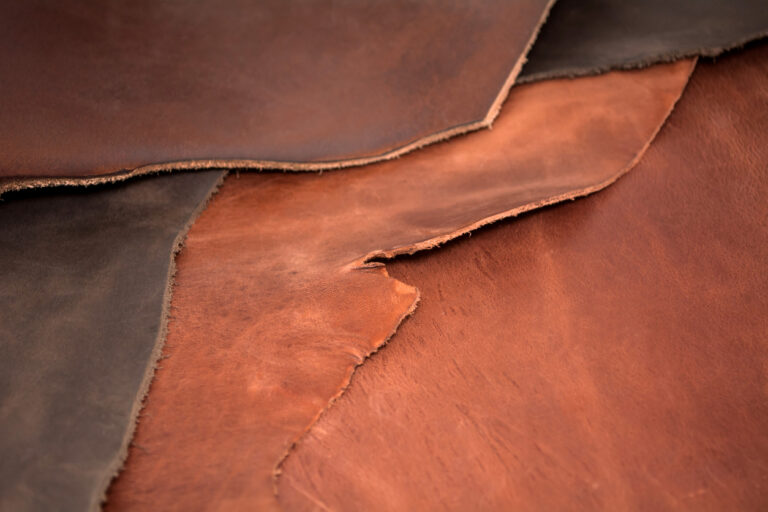
Full-grained leather is named as such as it is the thick top layer of the hide that retains its grain pattern which is highly valued as unique and authentic. This layer of leather is the part beneath the hair, and it is not chemically treated, sanded or buffed. Full-grain leather retains the original properties of the outer layer of an animal’s hide such as strength, durability, oil absorption and thickness. This type of leather is the most premium as it is the most durable and the heaviest. It is used to make leather goods with a more rustic finish as it retains characteristics from the original hide which other types of leather have removed. Full-grain leather typically outlasts most other types of leather and ages particularly well, the patina becoming more distinct over time. At Parnassus, we predominantly use full-grain leather for our products as it retains the characteristics of the hides, which makes every piece we produce unique.
Properties – strong, durable, visible unique grain, absorbs oils, contains blemishes, water-resistant, thick
Common uses – furniture, footwear, luggage, bags, harnesses, belts and holsters
Top-grain leather is made from full-grain leather, but the top layer of the hide is sanded and buffed to remove any imperfections from the upper grained layer, creating a uniform supple leather that is easier to manipulate. Top-grain leather is still a useful form of 100% leather and is valued for its pliability, softness and tactile finish. Often the leather is given an artificial grain to enhance its appearance, but removal of the natural grain also removes some of the useful properties of the hide. Top-grain leather doesn’t wear as well and doesn’t soften with age, it also won’t last as long. It is not as heavy as full-grain leather and although it is softer, doesn’t have the same rich patina full-grain leather has. Although it doesn’t perform quite as well as full-grain leather, top-grain leather is much more versatile and for this reason is popular.
Common kinds of top-grain leather include nubuck leather and suede. Nubuck leather is made from the top side of the top-grain leather giving it a more textured feel whilst suede is leather from the underside of the top-grain leather, making it much softer but less resilient.
Top-grain leather is relatively inexpensive and has a wide range of uses from handbags, purses and wallets to clothing, shoes and accessories. The tactile and consistent finish of this type of leather makes it a desirable material that doesn’t come with the high price tag of full-grain leather.
Properties – soft, supple, pliable, durable, affordable, versatile, needs processing
Common uses – bags, purses, wallets, belts, footwear, car upholstery, furniture, watch straps, clothing
Split leather is commonly referred to as genuine leather or corrected leather. The name ‘genuine leather’ is misleading as both types of leather listed above are genuine leather, so we’ll use the term split leather here for clarity. After the full-grain layer of the hide has been sliced away for use as full or top grain leather, the lower layer of the hide that is left is split leather. This leather is more fibrous and less durable than the top layers but still has a wide range of uses and is popular for everyday items as it is much more affordable than the more premium leathers.
Split grain leather needs more processing than other types of leather but gives a consistent finish that is smooth and free from imperfections. It is usually dyed, painted, stamped or embossed to achieve a finished appearance suited to a range of different products.
Suede also falls within this category of split leather. It is made from the inner surface of the hide, where the fibres are softer and more open, giving suede its signature velvety texture. While it shares the same base material as other split leathers, the finishing process is different: instead of coating or embossing, the surface is buffed to raise the nap and create a luxurious feel. Suede retains the pliability and affordability of split leather while offering a distinct tactile quality that makes it a popular choice for items such as shoes, bags, and linings.
To reduce the amount of waste in our production, at Parnassus we use our split leather, where the split is strong enough to produce suede. We create products that are perfectly suited for this type of leather.
Properties – lightweight, pliable, affordable, uniform appearance, suited to dying or spray painting, manipulable
Common uses – bags, belts, purses, wallets, keyrings, sandals, clothing, accessories
Bonded leather, often called reconstituted leather, is the name given to any products that contain even a small amount of leather, meaning that bonded leather products might contain 100% real leather, or they may contain a fraction. It is made from the offcuts and scraps of hides that are broken down into fibres and mixed with a filler compound to create a reconstituted type of leather.
Leather bonded in this way has a distinctive feel compared to other leather as it is man-made. It is the lowest grade of leather available and as such is the cheapest. It can be prone to cracking, splitting, peeling and flaking over time and is not as strong or durable as full, top or split leather.
On the one hand, using scraps to make bonded leather is an efficient way of reducing waste but this is outweighed by the fact that it can contain plastics and is heavily processed. Although not really leather, it is the most affordable type of leather and has been widely adopted by the fast fashion market for bags and purses with a polished aesthetic but one that doesn’t last.
Properties – lightweight, smooth finish, cheap, uniform in appearance, uses waste materials
Common uses – bags, purses, wallets, keyrings, sandals, clothing, accessories
Faux leather refers to any leather fabric made to look like or feel like leather without actually containing any animal hide. Types of faux leather include vegan leather like cork leather, and petrochemical-based pleather like polyurethane leather or PU leather, polyvinyl chloride leather or PVC and leatherette.
Faux leathers are affordable, water resistant and offer a leather-esque finish that appeals to many. Manufacturing leather from petrochemicals is not dissimilar to making clothing from petroleum based products, such as acrylic, nylon, viscose and polyester but these types of fabrics have a large impact on the environment. Whilst it may be affordable and can be processed to mimic the useful natural properties of real leather, faux leather is full of harmful chemicals and sheds microplastics which are then absorbed by people, plants and animals.
It is worth noting that some faux leathers such as plant-based leathers like leather fabric made from cork, fruit and vegetable leathers and leathers made from plants such as cacti or from leaves contain fewer, if any, nasty chemicals but they are highly processed and take more energy to make. Plant-based leather is a great alternative to vegan leathers for those who follow a vegan lifestyle as they don’t use animal products but do use natural materials as opposed to vegan leather made from petrochemicals.
Properties – water resistant, uniform in appearance, affordable
Common uses – bags, purses, wallets, keyrings, sandals, clothing, accessories
The world of leather is a complex one and understanding what your leather products are made from is not made easy by manufacturers. Leather products are rarely labelled with their ingredients or the origin of their hides if made from natural products.
This is why we ensure that our ethical leather is fully traceable, from farm to final product. We know exactly where our hides come from, how our cattle have been treated during their lifetime, adhere to regenerative farming practices exclusively and we know exactly how our hides have been processed. We work with responsible tanneries and use vegetable tanning only. We finish our hides in the most environmentally friendly way possible and lovingly look after our hides from farm to finish, all entirely within the UK. We hand make our products right here on the farm in the stunning Lake District safe in the knowledge that our leather has been reared, butchered and preserved in a way that is kind to the planet.
We aim to educate people on where their products come from so they can make informed decisions about the goods they buy, helping to precipitate change for the better, one bag at a time.
At first glance, the differences between real leather and vegan leather seem negligible. On further
Since the early 2000s small batch manufacturing has been reshaping how people think about consumption.